 WhatsApp Us



Internal Quality Assurance (IQA) is the practical work that keeps assessment, delivery, and quality calls fair, steady, and defensible. It is not just a final check of learner files before an external review. It is an ongoing process of monitoring, sampling, feedback, risk control, and continuous quality improvement.
Key Takeaways:
- Use risk-based IQA to ensure assessment decisions are fair, consistent, valid and evidence-based.
- Make IQA continuous through effective sampling, standardisation, feedback, action tracking and professional development.
- Turn findings into improvement by using IQA evidence to strengthen assessment practice, manage emerging risks and maintain quality standards.
A well-run IQA system helps an organisation spot issues early, support assessors, protect standards, and keep clear evidence of quality. It should sit inside daily practice, not only appear when an External Quality Assurance (EQA) visit is near. Sampling, calibration, feedback, and record checks are basic quality control methods.
This guide covers sampling, calibration, records, feedback, digital evidence, risk control, assessor growth, and EQA prep.
What does effective Internal Quality Assurance do?
Effective IQA gives an organisation confidence that assessment decisions are valid, reliable, and aligned with the required standards. It looks at more than whether the right papers are complete. It also checks whether learners are treated fairly, assessors understand the rules, and quality processes are used the same way across the team.
A strong IQA approach supports fairness by checking that learners are assessed consistently and that reasonable adjustments are applied correctly. It protects standards by confirming that assessor decisions meet award, organisational, and awarding body requirements. It also supports better practice by giving assessors useful feedback and growth opportunities.
Risk control is another key part of IQA. Common problems include uneven assessment decisions, weak evidence, poor feedback, weak record keeping, malpractice, or issues with remote assessment. Effective quality assurance spots these risks and acts before they spread.
The final part is audit readiness. The organisation should be able to show how quality decisions were planned, what was sampled, what was found, and what improved. Good records make that evidence easier to show.
The Internal Quality Assurance Cycle
IQA works best as a repeatable cycle, not a set of one-off checks. The process begins by identifying what needs to be quality assured. This may include programmes, units, assessors, learner groups, assessment methods, records, feedback, appeals, complaints, reasonable adjustments, and other risk areas.
Next, the sampling activity is planned. The plan should show what will be sampled, when it will be sampled, who will do the work, and why the sample was chosen. A clear reason is important because sampling should show professional judgement, not just meet a fixed number.
The planned checks can then be done through portfolio sampling, assessment observations, learner talks, feedback reviews, calibration, and checks of assessment conditions. Digital submissions and remote assessment may also need specific monitoring.
Findings should lead to clear decisions and feedback. IQA records should show the evidence reviewed, the decision reached, any action needed, who is responsible, and when the action must be done.
The cycle ends with review. Repeated issues may point to a need for assessor training, clearer guidance, changes to assessment materials, or wider process changes.
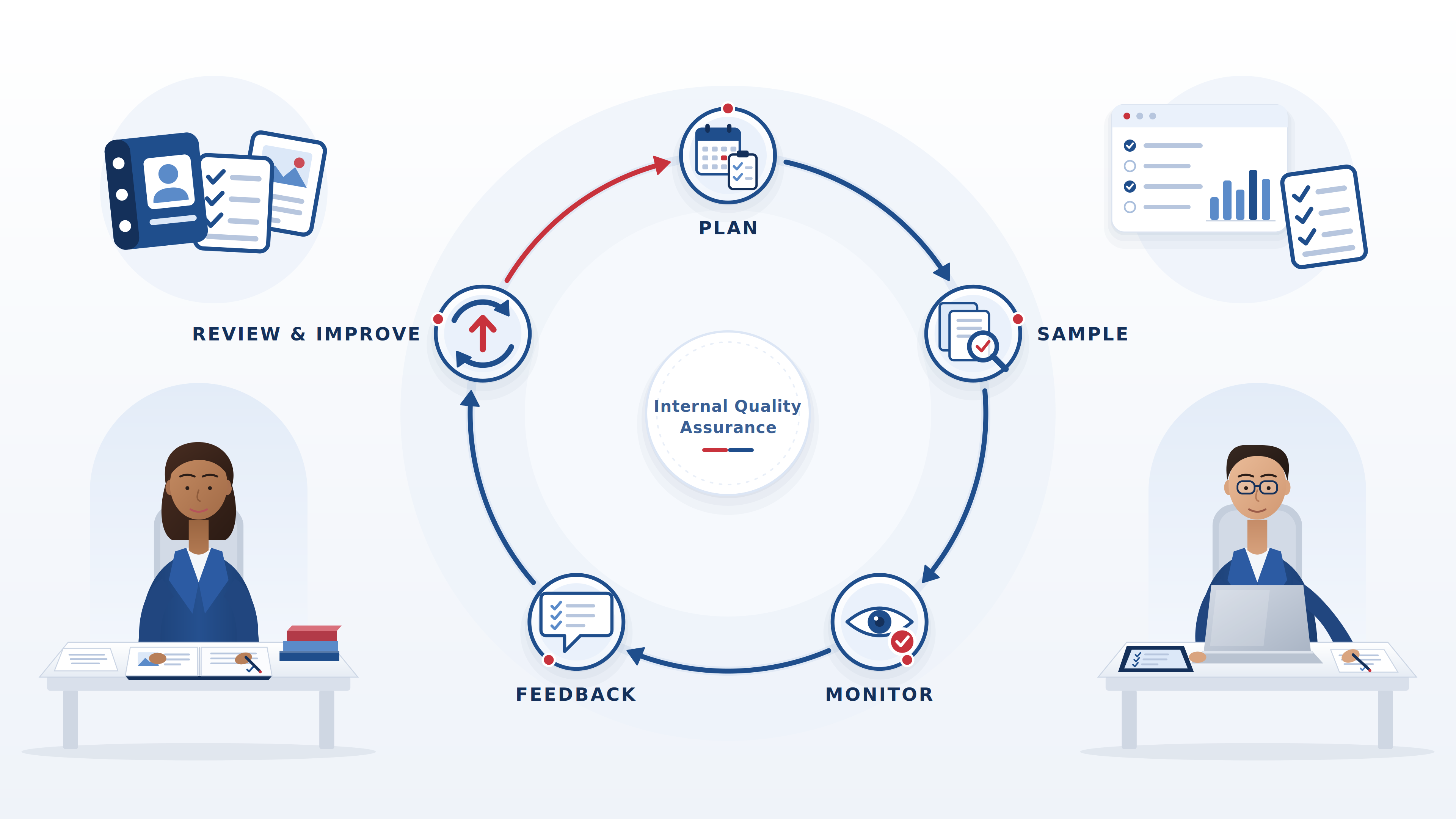
The key question here is simple: what did we learn, what changed, and how will we know the change worked?
Clear Roles and Accountability
Quality systems can weaken when staff are not clear about their jobs. The IQA role should have a clear duty to monitor assessment quality, support assessor growth, confirm calibration, keep IQA records, and prepare evidence for external review.
The organisation should also make clear who assesses learner work, who internally quality assures each assessment area, who signs off decisions where needed, and who monitors assessor actions and deadlines. Responsibility for calibration meetings, central IQA records, contact with awarding organisations, and policy updates should also be clear.
Clear accountability matters most when staff hold more than one role. Any conflict of interest should be spotted and managed. An IQA should not quality assure their own assessment decisions without proper independent oversight.
Read our blog, What is an IQA Qualification? Explained, to understand the role, requirements and benefits of becoming an Internal Quality Assurer
How to Design an IQA Sampling Strategy
An effective IQA sampling strategy should be risk-based, representative, and well documented. Sampling should give useful coverage of assessors, learners, assessment methods, units, and known risks rather than relying only on a fixed percentage.
One useful way to structure sampling is the ALMUR model: Assessors, Learners, Methods, Units and Risk. This gives a simple frame for checking that the sample is balanced and that key areas are not missed.
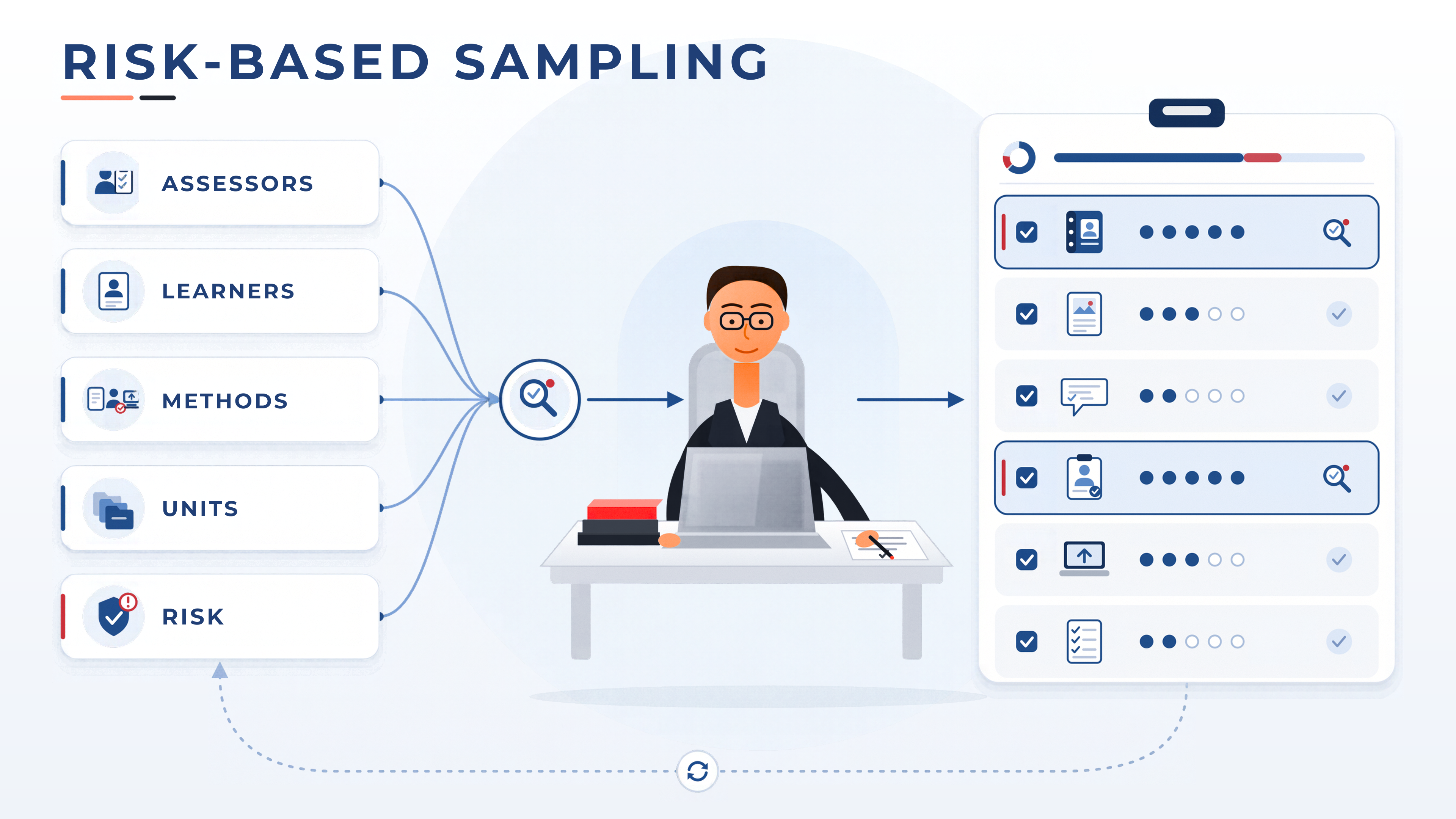
The assessor part should consider staff experience and situation. New assessors, experienced assessors, remote or associate assessors, and assessors with past actions may need different levels of monitoring. Learner sampling should include different groups, achievement levels, needs, locations, and reasonable adjustments where relevant.
Assessment methods should also be covered. Depending on the award, this may include assignments, observations, professional talks, tests, projects, witness testimony, simulations, and digital evidence.
Units and standards should be considered with risk. Mandatory and optional units, recently changed requirements, high-risk criteria, low achievement, and high resubmission rates may need more attention.
Risk should shape the frequency and depth of sampling. New staff, new delivery models, complaints, appeals, malpractice concerns, use of AI, remote assessment, weak records, or uneven feedback may all justify closer monitoring.
Timing matters too. Sampling should happen early enough for problems to be found and fixed before they affect more learners. Where an action has been raised, later sampling should check whether it has been done and whether the change worked.
Across the year, the organisation should also watch coverage so that no assessor, unit, or assessment method drops out of the IQA process.
Calibration Keeps Assessor Decisions Aligned
Calibration helps assessors interpret standards and evidence needs in the same way. It cuts assessor drift and supports reliable decisions across different assessors, locations, and delivery methods.
Good calibration should be based on evidence, not just attendance. For example, assessors can review real or redacted learner evidence, assessment criteria, borderline calls, and feedback examples.
A useful session starts by picking a unit, criterion, or assessment method and sharing suitable evidence before the meeting. Assessors should make their own decisions before comparing them with colleagues. Any differences can then be discussed against the relevant criteria and evidence needs.
The group should agree what suitable evidence and useful feedback look like, and they should record any changes needed to guidance. The issue should then be checked again through later IQA activity to confirm that the agreed approach is being used.
Calibration records should show what was discussed, who attended, what was agreed, and what follow-up is needed. Staff who could not attend should get the outcome and any needed briefing.
IQA Feedback Should Improve Practice
IQA feedback should be specific, fair, timely, and linked to the relevant standards. It should explain what was checked, what was done well, what needs attention, and why the issue matters.
Good feedback is evidence-based and should refer to samples, observations, or records where useful. It should link the finding to assessment criteria, organisational rules, policies, procedures, or awarding body guidance. It should also recognise good practice, not just weak points.
Most important, feedback should lead to a clear action. The action should say what must change, who is responsible, and when it must be done. Follow-up should then check whether the action was completed and whether it had the intended effect. Where useful, the IQA should also include coaching, training, or calibration as part of the change.
For example, instead of simply recording Improve Learner Feedback, an IQA action could ask the assessor to link feedback to the right assessment criteria, identify missing evidence, and give a clear next step. The action can then be checked by sampling later feedback on an agreed date.
Records Make the Quality System Visible
Clear records show that IQA activity happened and that it led to decisions and improvement. They also make External Quality Assurance easier because evidence can be found without rebuilding the quality file just before a review.
A good record system should bring together IQA plans, sampling reasons, completed IQA reports, assessor feedback, action logs, and calibration records. Depending on the organisation and award, it may also need learner or employer feedback, assessor competence and CPD evidence, reasonable adjustment and special consideration records, malpractice and appeal records, and external quality assurance reports with responses to actions.
Digital systems can make this easier, but technology does not replace good quality assurance. Missing dates, unclear file names, incomplete records, and untracked actions can weaken a digital system just as they can weaken a paper one.
The aim should be a clear audit trail showing what happened, what was found, what decision was made, what action followed, and whether the action improved practice.
Develop Your IQA Skills
Explore the Level 4 IQA Award and start building your quality assurance skills today.
Enrol NowRisk-Based Internal Quality Assurance
Quality risk is not only about wrong assessment decisions. Risks can also come from technology, workload, unclear policies and procedures, weak communication, poor resources, assessor confidence, or learner confusion.
Common risks include uneven assessor decisions, unclear feedback, and weak or invalid evidence. Organisations should also consider plagiarism, malpractice, collusion, identity concerns, and the chance that submitted work does not show the learner's own competence.
The growing use of AI tools adds more to think about. Remote assessment can also create risks around identity, observation, assessment conditions, and technology. Other risks may arise where staff do not have enough time or resources to complete assessment and IQA work properly.
A risk-based IQA system does not treat every area as equal. Instead, it gives more monitoring to areas where the chance or impact of a quality problem is higher.
Ready to Lead Internal Quality Assurance?
Take your IQA practice further with the Level 4 Certificate in Leading the Internal Quality Assurance of Assessment Processes and Practices (RQF).
Explore the Level 4 Leading IQA CertificateAI and digital evidence in assessment
AI tools have added new points for assessment and Internal Quality Assurance. Organisations should have clear policies and procedures so that learners, assessors, and IQAs know what AI use is allowed and what evidence is needed.
Where concerns arise about learner evidence, the organisation should follow its own process rather than rely on assumptions or a single detection tool. Depending on the award and assessment rules, extra evidence may include professional discussion, questioning, version history, oral checks, observation, reflective accounts, workplace evidence, or learner declarations.
The aim is sound assessment decisions based on the learner's own knowledge, skills, and competence.
Digital controls can also support IQA. File naming, timestamps, access rights, identity checks, and audit trails can help build a clearer assessment record. However, system data alone may not prove who created the work or whether the assessment decision itself was sound.
IQA competence and continuing professional development
In UK education and training, the Level 4 Award in Internal Quality Assurance is often linked to the IQA role, while older awards such as V1 and D34 may still be found in some settings.
However, holding an award is not enough on its own. An effective IQA also needs current work or subject knowledge, assessment knowledge, evidence review skills, and the confidence to challenge assessment decisions in a fair and professional way.
CPD should fit the role and the risks found. This may include awarding body updates, calibration and cross-calibration, peer review, learning from EQA reports, assessment method updates, digital and data protection awareness, subject development, difficult feedback talks, and malpractice or appeals training.
The best CPD is tied to real quality findings. If sampling finds a repeated problem with one assessment method, for example, development should deal with that issue rather than add unrelated training to the CPD record.
How IQA Supports Quality Management Systems
Internal Quality Assurance should connect with the wider
When an issue is found, the organisation should first work out what is happening and then look at the root cause. The cause may be linked to knowledge, processes, resources, workload, communication, or unclear guidance.
An action should then be agreed with a named owner and an expected result. Where needed, the organisation can support change through training, coaching, revised templates, or clearer guidance. The impact should then be checked through more sampling, observation, assessment results, or other suitable evidence.
When the change works, the learning should be built into the quality system. This may mean updating policies, procedures, induction materials, assessment guidance, or calibration resources.
This turns IQA from a paperwork task into a real
Build Your Career in Internal Quality Assurance
Equip yourself with the skills to monitor assessors, maintain quality and support continuous improvement across your organisation.
Explore IQA QualificationsBuilding a Culture of Quality
Strong IQA depends on culture as well as process. Staff should see quality assurance as part of professional practice while still accepting fair, evidence-based challenge.
Leaders have an important role in building this culture. IQA findings should be used to improve training, resources, assessment processes, and the learner experience rather than just being recorded and closed.
A healthy quality culture lets assessors raise questions early, expects IQAs to challenge decisions with respect, and keeps talk focused on evidence and learning. It also acts on external feedback and checks whether improvements actually worked.
When staff understand that IQA is meant to support reliable assessment and




.png)