 WhatsApp Us



As generative artificial intelligence transforms how learners research, write, practise, revise and solve problems, a pivotal question emerges for educators, trainers and assessors: if AI can deliver answers in seconds, how should assessment evolve?
The answer isn't to dismiss AI or to try to catch every instance of AI-generated text. It is to think carefully about what we assess, how learners showcase their achievements, how evidence is validated, and how AI can be used responsibly without overshadowing the learner's own critical thinking.
Key Takeaways:
- Focus on the learner’s process, authentic application, reflection, observation and professional discussion.
- Learners should declare AI use, identify tools, and retain prompts and unedited outputs.
- Protect personal data, follow UK GDPR, and ensure AI supports rather than replaces professional judgement
This matters most in UK vocational training, where assessment must still produce valid, reliable and genuine evidence of a learner's knowledge, skills and understanding. Used well, AI is not only a threat to that aim. It is a chance to build assessment that is more meaningful, more transparent and closer to real practice.
How Is Generative AI Impacting Assessment?
Generative AI can now produce written explanations, lesson plans, summaries and presentations. The Department for Education (DfE) recognises that it can support tasks such as resource creation and tailored feedback, while also flagging risks such as inaccuracies and the misuse of personal data. [3] Assessors therefore need to understand both the benefits and the limits of these tools, and design assessments that encourage responsible use.
The difficulty is that a polished submission can reveal very little about the learning behind it. A well-written document may say nothing about:
- how the learner developed their ideas
- the research they actually undertook
- their real comprehension of the subject
- how they responded to feedback
- how they would apply the knowledge in practice
- how they evaluated different sources
- the decisions they made along the way
So the critical inquiry goes beyond 'Did the learner use AI?' It becomes:
What This Means for Assessors, IQAs and Learners
Assessors. Your professional judgement matters more, not less. Confirming that evidence is the learner's own now means looking at how it was produced, not only at how it reads.
Internal quality assurers. Sampling should cover the evidence trail (drafts, declarations, observation notes) as well as the final product. Standardisation meetings are a good place to agree how AI declarations are reviewed and what triggers a follow-up conversation with the learner.
Learners. Clear rules at the start of each assignment protect learners too. When they know what is allowed, what to declare and what to keep, they are far less likely to drift into malpractice by accident.
Formative Assessment Is More Valuable Than Ever
Formative assessment takes place during learning and gives both learners and educators insight into progress. Questioning, quizzes, discussions, draft work, peer assessment, feedback, observation, reflective activities, practical demonstrations, presentations and self-assessment all reveal thinking that a finished document cannot.
Generative AI doesn't make these methods obsolete. It increases their value, because educators can focus more on process, application, explanation, reflection and authentic performance. Take a familiar task:
|
Example: from essay to evidence trail Before: "Write an essay explaining the benefits of inclusive teaching." After: the learner works through a sequence, and each step leaves evidence:
|
The result is a far more complete picture of learning than a single submitted document.
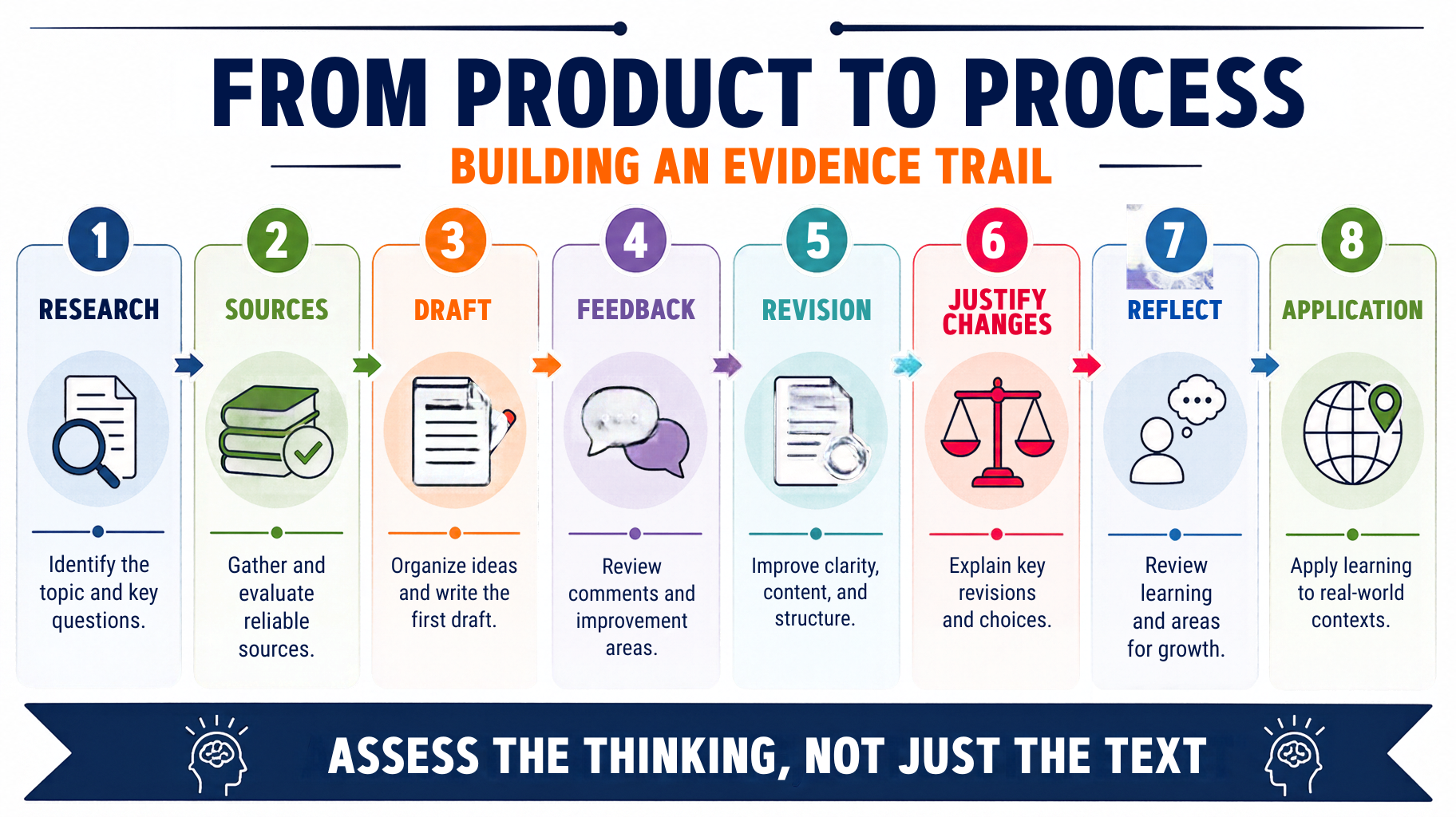
Shifting Focus: Measuring Thinking Over Text
AI invites us to rethink the role of the final written submission. Well-crafted documents are valuable, but they may not capture the full range of knowledge and skills a qualification demands. Give learners more chances to show:
- Critical thinking: why they chose an approach, and where they challenged an AI output.
- Evaluation skills: how they compared and judged sources.
- Practical application: using knowledge in a realistic scenario.
- Reflective insight: what they learned and what they would change.
- Clear communication: explaining their work aloud, not just on paper.
- Practical competence: doing the job, observed in real time.
These methods are especially relevant in vocational education, where practical skills often need to be demonstrated beyond written responses.
Authenticity Remains Crucial in the Age of AI
With AI comes an amplified need for authenticity. For regulated qualifications, learners must still meet the criteria in the qualification specification and follow assessment regulations. JCQ's guidance is clear that centres should accept only work that belongs to the learner:
'must only accept work for qualification assessments which is the students' own'
Joint Council for Qualifications (JCQ), AI Use in Assessments: Your role in protecting the integrity of qualifications, Revision two, 30 April 2025
Misusing AI to the point that submitted work is no longer the learner's own can amount to malpractice, and where AI use is permitted it should be properly acknowledged. Which rulebook applies depends on the qualification:
| Qualification type | Main rulebook | Check |
|---|---|---|
| GCSE, A level and similar | JCQ guidance plus the awarding body's own policy | Declarations, supervision, malpractice reporting |
| Ofqual-regulated vocational qualifications | The awarding organisation's AI and malpractice policy | Permitted AI use, evidence rules, sanctions |
| Your centre | Your AI, assessment and data protection policies | Clear learner-facing wording, consistent application |
If concerns arise about a learner’s submission, our guide explains what to do when an assignment is flagged as AI-generated and how to approach the situation fairly.
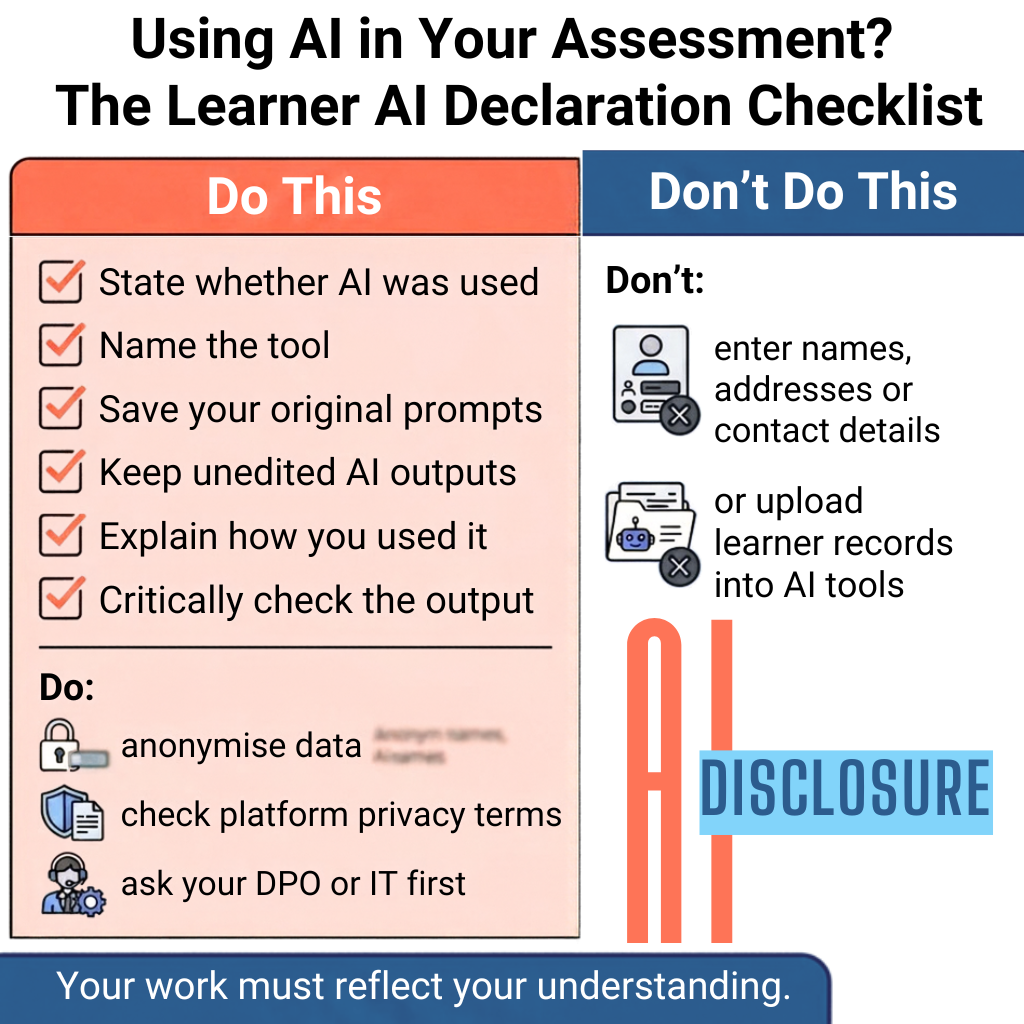
A practical AI declaration checklist
Requirements vary by awarding organisation, so confirm the detail in your own policy. As a baseline, ask learners to:
- State whether AI was used
- Name the AI tool or platform
- Save the original prompts and unedited outputs
- Explain how AI was used and which parts it influenced
- Critically check AI content before including it
Also set out accepted and prohibited uses at the start of each assignment, and use more than one route to confirm authenticity rather than relying on how polished a submission looks.
Five Common Mistakes in Centre AI Policies
- Being vague. 'Use AI responsibly' isn't a rule. Say what is permitted, what is prohibited and what must be declared.
- Relying on detection alone. Detection tools can't replace evidence of process and professional discussion. For more detail, read our guide on whether AI detection tools can reliably identify ChatGPT in academic writing .
- Ignoring the awarding organisation. Its policy is the one that governs your qualification.
- Forgetting staff training. A policy only works if assessors and IQAs apply it consistently.
- Treating AI as only a risk. Teaching learners to fact-check and critique AI is part of preparing them for work.
AI as an Assessor's Tool, Not an Assessor
AI isn't only something learners use. Jisc's National Centre for AI in Tertiary Education has been running a year-long AI in assessment project from September 2025, trialling tools that support marking and feedback in further and higher education. [4] The promise is faster, more consistent feedback and a lighter marking load. The caution is just as important: accuracy and consistency of AI-generated marking are still open questions.
If you use AI to support your own assessment workload, keep these guardrails in place:
- The assessor, not the tool, makes the final judgement.
- Sample and check AI-generated feedback before it reaches learners.
- Never paste identifiable learner work into an unapproved tool.
- Tell learners how AI is, and isn't, used in marking.
Ready to assess with confidence?
If you want to become a qualified assessor and learn to judge evidence, authenticity and learner competence properly, this Ofqual-regulated qualification is built for you.
Enrol Now!Six Strategies to Innovate Assessment in the AI Era
1. Evaluate the process alongside the product
Document the learning journey through planning notes, drafts, feedback and records of AI use. This creates a clear evidence trail and reinforces that assessment showcases learning, not just the submission of a document.
2. Incorporate authentic and applied tasks
Tasks that mirror real-world scenarios make it harder for assessment to become text generation. Rather than asking a learner to explain assessment theory, ask them to design and evaluate an assessment activity for a specific group.
3. Embed reflection
Reflection illuminates understanding. Useful prompts include:
- What was your rationale for this approach?
- What evidence shaped your decisions?
- How did feedback influence subsequent changes?
4. Use professional discussions and questioning
Questions such as "Why did you choose this approach?" or "What evidence supports your conclusion?" push learners to articulate decisions and add depth beyond the written submission.
5. Enhance observation and practical demonstration
In vocational education, direct observation is paramount. Where learners must demonstrate practical skills, written descriptions alone may not suffice. Combine real-time observation, questioning, professional discussion and other evidence types permitted by the qualification.
6. Teach Learners How to Use AI Responsibly
Embracing AI doesn't have to mean fear. Learners may need guidance on appropriate and inappropriate AI use, fact-checking AI outputs, bias, hallucinations and academic integrity. Educators can also explore practical ways to balance AI assistance with academic integrity while ensuring technology supports rather than replaces genuine learning.
As the DfE's briefing for school leaders puts it:
"You know your students. If something doesn't sound like them, question it."
Department for Education, Senior leadership team briefing pack: AI and coursework integrity, GOV.UK, March 2026 [2]
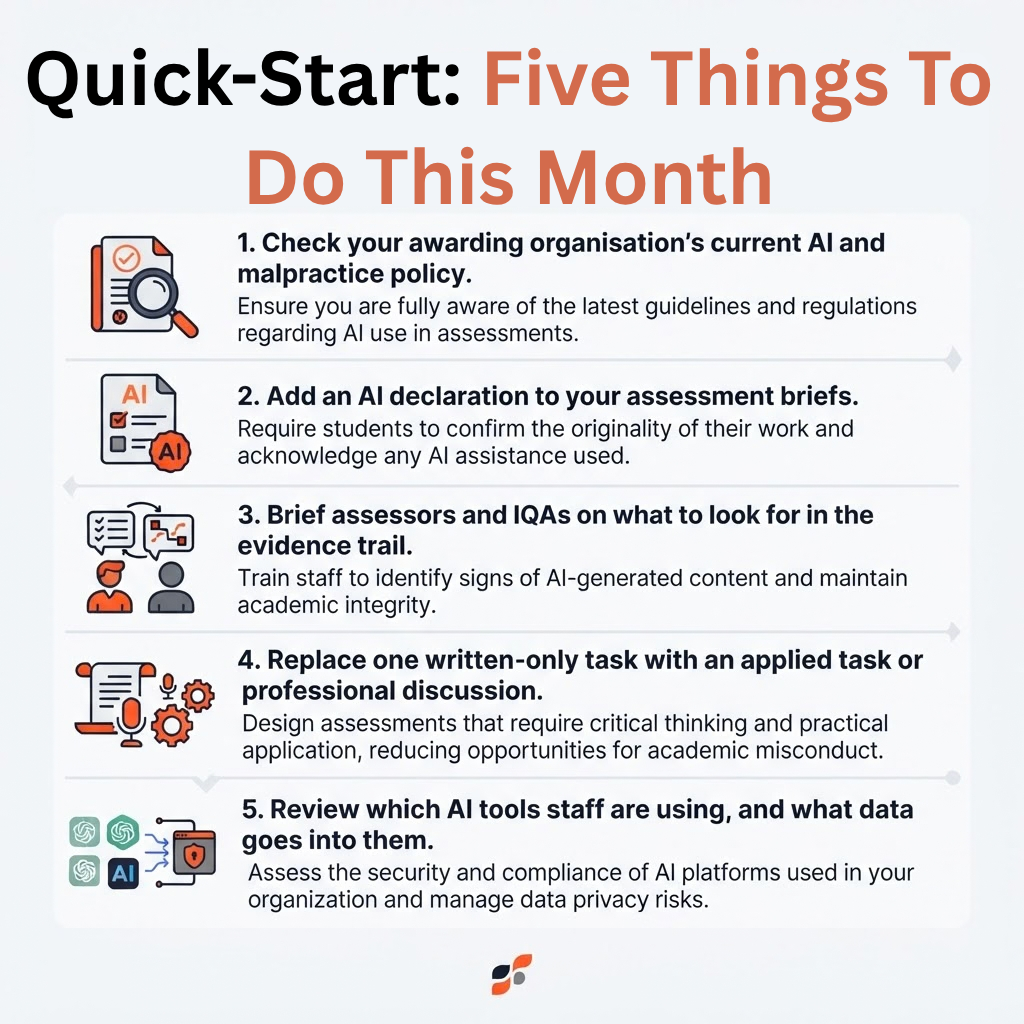
Quick-Start: Five Things to Do This Month
Want to use AI responsibly in your teaching and training?
Build the skills to use AI ethically, effectively and safely in education, including data protection and academic integrity.
Know more about 👉 Level 3 Award in Artificial Intelligence (AI) in EducationConclusion
Generative AI isn't the end of meaningful assessment. It's a prompt to make assessment better. When we focus on process, authenticity, reflection and professional dialogue, a polished final document stops being the only proof of learning. Learners still need to demonstrate their knowledge, skills and understanding, and assessors still need to be confident the evidence is genuinely theirs.
The path forward is not to ban AI or chase detection tools. It is to set clear expectations, require transparency, protect learner data and design tasks that show real competence. Done well, AI becomes a tool for learning rather than a shortcut around it, and human judgement stays at the centre of assessment. To build those skills, explore our Level 3 CAVA assessor qualification or the Level 3 Award in AI in Education.




.png)