 WhatsApp Us


Imagine a student standing at a literal crossroads: one path leads to a three-year university degree and mounting debt; the other leads to a high-level apprenticeship. This is the moment when the right conversation helps make a decision. The proper guidance can help a young person overwhelmed by choice or an adult facing the sudden shock of redundancy. Advice and guidance are helping professions that carry a profound responsibility.
Key Takeaways:
- A successful career in advice and guidance depends on developing practical skills that translate knowledge into confident, ethical professional practice.
- Understanding the responsibilities and boundaries of the IAG role is fundamental before committing to qualification or career progression decisions.
- Structured, continuous development ensures your skills remain relevant, credible and aligned with evolving client needs and labour market expectations.
Information, advice, and guidance (IAG) are not about giving suggestions and sharing information. It requires structured listening, ethical judgement, labour-market awareness, and the ability to ask the right questions without imposing personal opinions.
Professionals and students rely on the IAG officer to provide clarity, accuracy and reassurance. This is the reason it is important to demonstrate strong communication, sound decision-making, professional boundaries and practical competence before starting a career in IAG.
This blog will explore the essential competencies required and how you can develop them in a structured, strategic way.
What is the Role of an Advice and Guidance Professional?
It is fundamental to understand the role of advice and guidance before building relevant skills. IAG professionals support individuals in making informed decisions about education, training and employment, often during periods of uncertainty or transition.
The role includes providing career guidance, educational advice and employability support. This may involve helping a student choose suitable subject pathways, guiding an adult learner through further study options, or assisting a jobseeker in identifying transferable skills. You may conduct one-to-one guidance sessions, deliver group workshops on CV writing or interview preparation, and support clients in setting realistic action plans.
It also requires accurate knowledge of labour market trends, qualification frameworks and progression routes. Advisers are expected to present balanced information, explore options objectively and encourage clients to make decisions based on evidence rather than pressure.
Ethical Responsibilities and Professional BoundariesEthics are central to this profession. You are entrusted with personal information and sensitive discussions, which require strict confidentiality and data protection awareness. Advisers must remain impartial, avoiding personal bias when presenting options.
Professional boundaries are equally important. The role involves signposting to appropriate services where necessary, maintaining objectivity, and ensuring that support remains structured and professional.
Understanding these responsibilities clarifies why this career demands more than enthusiasm. It requires accountability, awareness and a strong ethical foundation.
Core Skills You Must Develop for an IAG Role
A career in Information, Advice and Guidance demands a blend of interpersonal strength, analytical thinking and professional discipline. These skills shape how effectively you support clients and how confidently employers trust your judgement. The following are the few core skills that you have to develop to work in an IAG role.
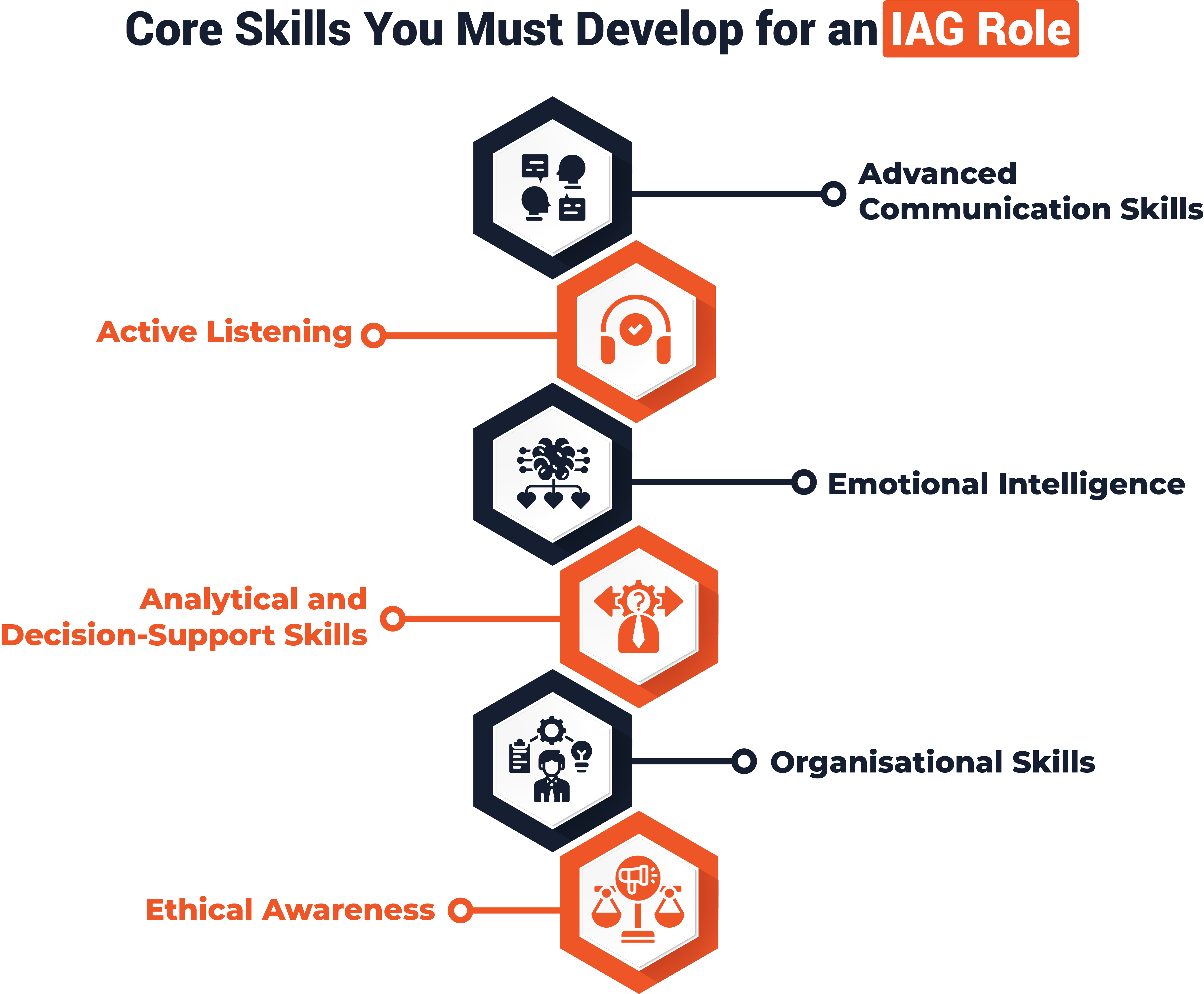
Clear and purposeful communication sits at the centre of IAG practice. You must listen actively, ask structured questions and interpret both verbal and non-verbal cues. Clients often struggle to articulate their concerns, so your ability to guide conversations with clarity and patience makes a measurable difference.
Written communication is equally significant. Whether drafting action plans, maintaining case records or preparing reports, accuracy and professionalism reflect your credibility.
Active ListeningAn IAG career requires focus, neutrality and the ability to identify underlying concerns. Active listening and right questioning encourage clients to reflect on their strengths, interests and barriers without feeling judged.
For example, a client may say, "I just don't think university is for me." Instead of moving on quickly, you might respond, "Can you tell me what concerns you most about university?" This simple follow-up can uncover financial worries, confidence issues or misconceptions. Open questions help explore possibilities, while targeted questions clarify practical steps. When used effectively, these techniques move conversations from uncertainty to structured decision-making.
Emotional IntelligenceClients approach you during periods of stress, career uncertainty or personal transition. Emotional intelligence allows you to respond with sensitivity while maintaining professional boundaries.
The role is to guide objectively, not to become emotionally involved. Recognising this distinction strengthens both client relationships and professional integrity.
Analytical and Decision-Support SkillsIAG professionals assess qualifications, career pathways, labour market information and progression routes. This requires analytical thinking. You must evaluate options logically, compare pathways and present realistic outcomes.
Strong analytical skills ensure guidance remains structured and credible. For instance, if a client is choosing between an apprenticeship and full-time study, you may help them weigh entry requirements, earning potential, long-term progression and personal circumstances.
You can provide guidance based on evidence and evaluate the advantages and limitations rather than advising on what to choose.
Organisational SkillsOrganisation skills are consistently required to manage appointments, maintain accurate records, and follow up on agreed actions. Poor record-keeping can affect compliance, safeguarding and service quality.
Effective case management demonstrates reliability. It ensures that guidance sessions are not isolated conversations but part of a coherent support process.
Ethical AwarenessConfidentiality, impartiality and safeguarding awareness are foundational in IAG roles. You are responsible for protecting sensitive information and ensuring advice remains unbiased.
Understanding when to refer clients to specialist services is equally critical. Maintaining clear professional boundaries protects both the client and your professional standing.
What Should Your Personal Development Plan Include to Start a Career in IAG?
A structured Personal Development Plan (PDP) brings direction to your career in Information, Advice and Guidance. Without a clear plan, skill development can become reactive and inconsistent. A PDP allows you to evaluate where you stand professionally, where you need to improve, and how you will move forward in a measurable way.
Step 1: Self-AssessmentAsk yourself simple but direct questions:
- What am I already confident doing in client sessions?
- What type of clients do I want to support?
- Where do I hesitate or feel uncertain?
- What feedback have I received from supervisors or peers?
- Do clients seem clear and confident after speaking with me?
This will help you build self-awareness, which is the foundation of professional growth.
Step 2: Identify Specific Skill GapsReflect with clarity:
- Do I fully understand progression routes and labour market trends?
- Am I comfortable handling complex or emotional cases?
- Do I need to improve my questioning or case recording skills?
- Where could my knowledge be deeper or more current?
Turn reflection into action by asking:
- What can I improve within the next three months?
- What qualification level aligns with my current role?
- Which training provider should I go for?
- What experience do I need before applying?
- Where do I want to be professionally in two to five years?
Short-term goals build momentum. Long-term goals create direction. Together, they ensure your development remains structured, realistic and purposeful rather than aspirational.
Take Your Career to the Next Step!
Gain the skills, confidence and professional recognition required to progress in Advice and Guidance.
Conclusion
Advice and guidance are a people-centred profession built on responsibility and informed judgement. Every interaction has the potential to influence someone's educational or career direction, which makes competence a professional obligation. Continuous learning, reflective practice and regular professional development are part of sustaining credibility in IAG. Labour market trends change, qualification frameworks evolve, and client needs become more complex. Staying current ensures the support you provide remains accurate and relevant.



.png)