 WhatsApp Us



If you have spent years mastering a trade, a care role or a professional discipline, you already hold much of the knowledge that vocational assessors need. But have you ever considered using that knowledge to help others achieve recognised qualifications? The harder part is turning that expertise into a recognised qualification that lets you judge other people's competence fairly.
Key Takeaways:
- Your industry experience is the foundation, but assessing against standards is a separate skill you must learn.
- Choose your Level 3 route by setting. CAVA covers workplace and training assessment, while the Principles and Practices Award is theory-only.
- Practical units need real learners, so secure access before you enrol.
To become a qualified assessor in the UK, you generally need relevant industry expertise, occupational competence and an appropriate assessor qualification, such as the Level 3 Certificate in Assessing Vocational Achievement (CAVA). The exact route depends on whether you want to assess learners in the workplace, in a training environment or both.
This guide explains how to become a qualified assessor in the UK, which Level 3 assessor qualification suits your situation, and what to do before your first assessment.
Quick Answer: To become a qualified assessor in the UK, you usually need occupational experience in the area you will assess, a recognised Level 3 assessor qualification such as the Level 3 Certificate in Assessing Vocational Achievement (CAVA), and access to learners for any practical assessment. Requirements vary by sector and awarding organisation, so check them before you enrol.
Why Your Industry Experience Could Be the Start of Something New
Professional experience is valuable because it gives you something that textbooks alone cannot provide: an understanding of how work is performed in real situations.
A construction supervisor knows what safe working practices look like on-site. An experienced care professional understands the importance of delivering appropriate support. A hospitality manager can recognise whether someone demonstrates the skills needed to work effectively in a busy service environment.
These are the kinds of insights that support vocational assessment. However, being experienced in a profession and being qualified to assess others are not exactly the same.
As an industry expert, you understand how to perform a task. As an assessor, you must also know how to evaluate someone else’s performance against established qualification standards. That is where professional assessor training becomes important.
Why this Journey Matters for Quality and Trust
Strong assessment protects more than pass rates. It protects learners, employers, and the value of the certificate itself. A person may be excellent at the job, yet still need training to judge learner evidence in a fair and consistent way. That matters because assessment standards must be applied the same way across different learners, sites, and assessors. If one assessor is too strict and another is too loose, the qualification quickly loses trust. Good assessment also supports growth, because the learner gets clear direction rather than a simple sign-off. The wider quality assurance approach used by awarding organisations exists for this reason.
What Does a Qualified Assessor Do?
A qualified assessor evaluates a learner's knowledge, skills and occupational competence against the standards of a vocational qualification. Rather than marking exam papers alone, assessors often watch learners perform practical tasks, review portfolios and ask questions about how they apply their knowledge at work.
Their responsibilities typically include:
- Planning assessment activities according to qualification requirements.
- Observing learners performing relevant practical tasks.
- Reviewing written work and other evidence of competence.
- Conducting professional discussions and asking assessment questions.
- Providing clear and constructive feedback.
- Maintaining accurate assessment records.
- Making fair, consistent and evidence-based assessment decisions.
- Working with internal quality assurers to maintain assessment standards.
For example, an experienced childcare practitioner who becomes an assessor might observe a learner's professional practice, review their evidence and decide whether that performance meets the relevant criteria.
The key difference is that assessors do not make decisions based purely on personal preference. They evaluate evidence against specific occupational or qualification standards.
Read our blog to learn more:
Step-by-Step: How to Become a Qualified Assessor in the UK
There is no single career route that suits every professional. However, most people transitioning from industry into vocational assessment will follow several important stages.
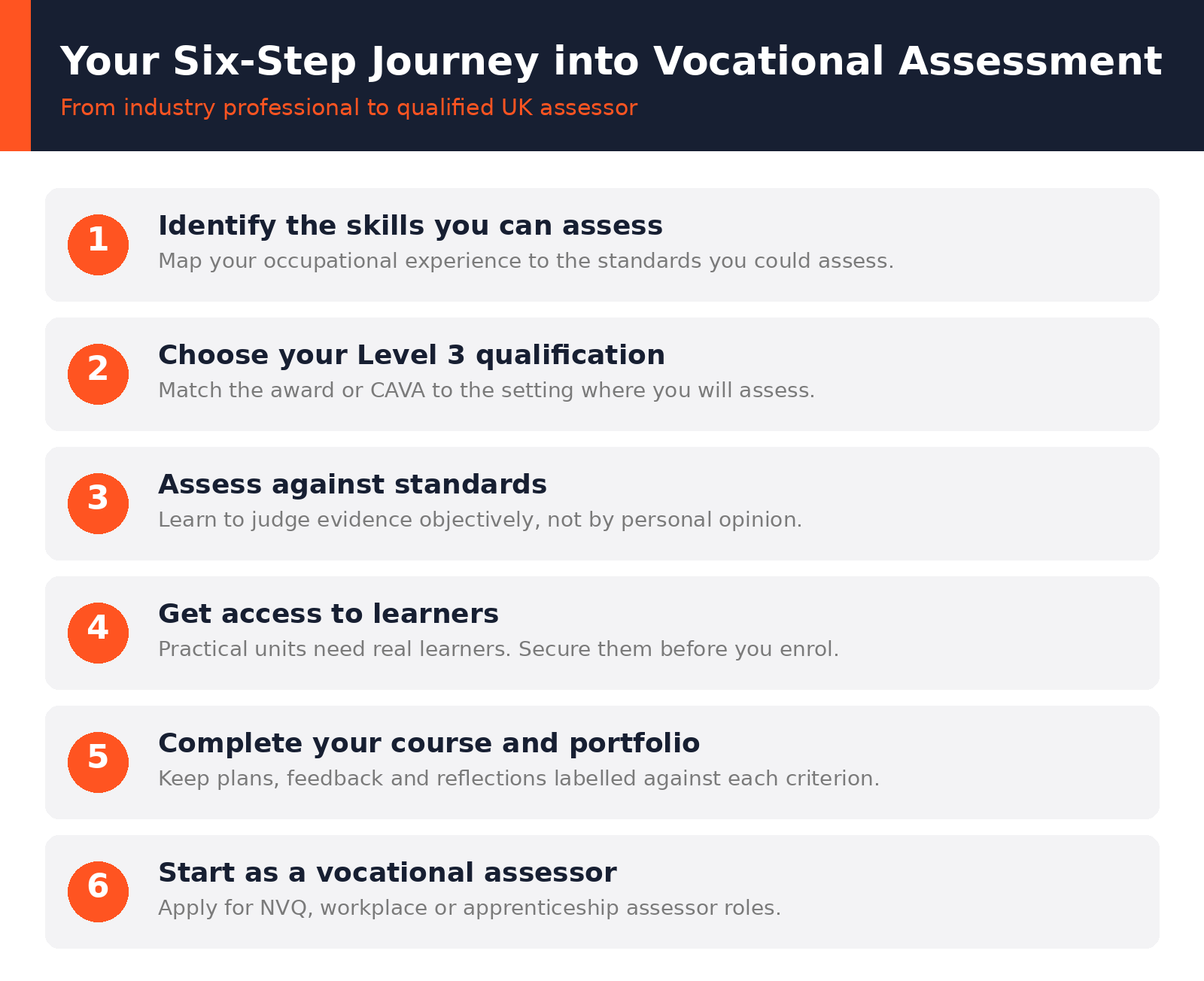
Career roadmap from industry experience to vocational assessment.
Step 1: Identify the Occupational Skills You Can Assess
Begin by examining the experience you already have. What qualifications, practical abilities and professional responsibilities have you developed throughout your career? Consider the areas in which you could confidently evaluate another person's work.
For instance, an experienced retail supervisor may be interested in assessing customer service or retail operations. Someone with a background in health and social care may wish to assess vocational learners working towards care-related qualifications.
Your background should align with the occupational standards you intend to assess. The UK's National Careers Service notes that the college-course route into an assessor role requires industry experience and at least a Level 3 qualification in the type of work you intend to assess. Employers and awarding organisations may set additional requirements.
Step 2: Understand Which Assessor Qualification You Need
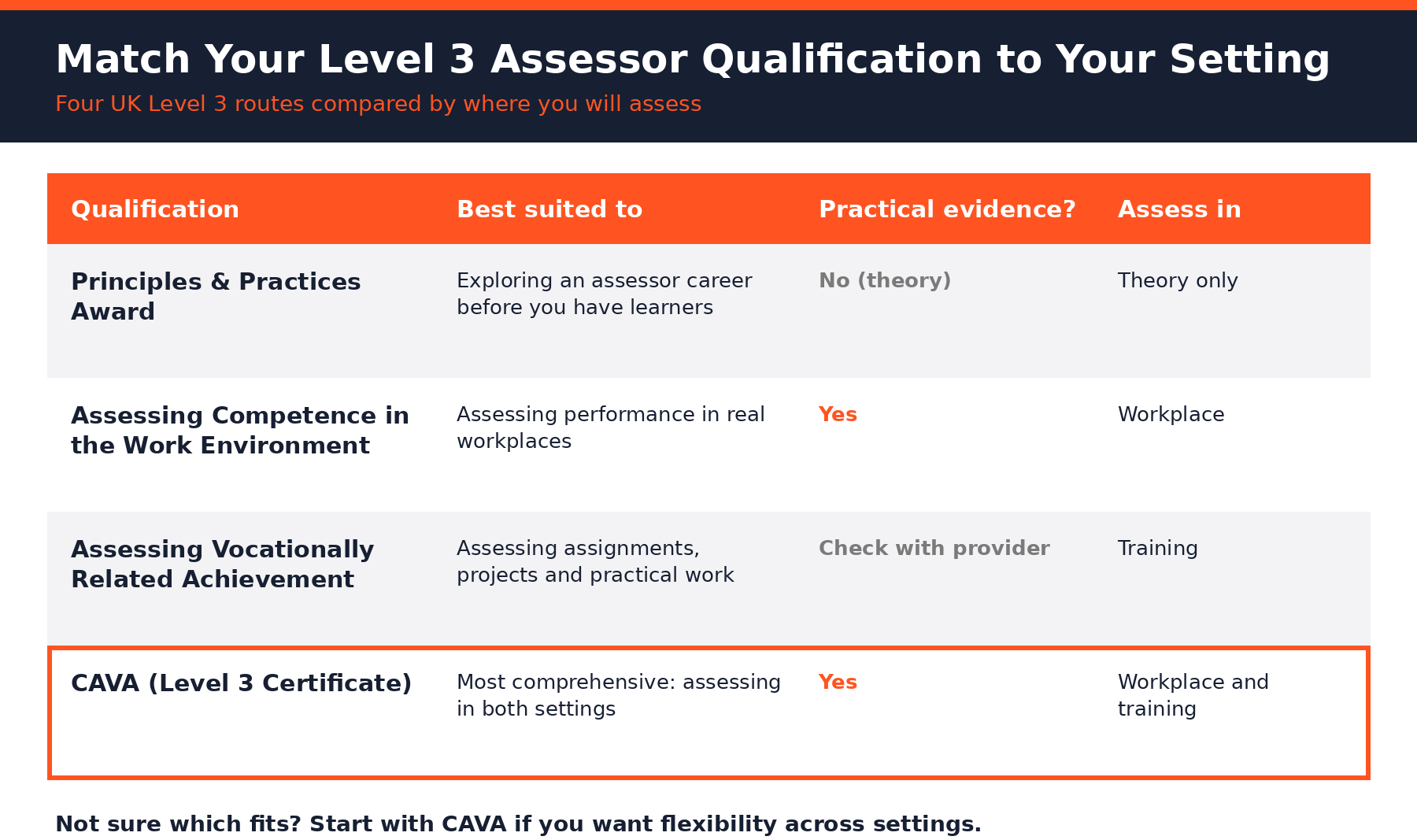
Once you know your area of expertise, the next step is selecting the right assessor qualification in the UK. There are different Level 3 assessor qualifications, each designed for a particular type of assessment activity.
Level 3 Award in Understanding the Principles and Practices of Assessment
This knowledge-based qualification introduces the fundamental principles of assessment, including planning, methods, decision-making, record-keeping, quality assurance and professional responsibilities. It is useful if you are exploring an assessment career but do not yet have access to learners. Because it is theory-based, it does not require practical assessment observations. However, completing this award alone does not demonstrate practical competence for all vocational assessor roles.
Explore the Level 3 Principles and Practices Assessor Award →
Level 3 Award in Assessing Competence in the Work Environment
This qualification is designed for professionals who assess occupational competence in real workplace settings. It can suit individuals whose responsibilities involve directly observing how learners perform their duties, for example in construction, hospitality or care.
Explore the Workplace Competence Assessment Award →
Level 3 Award in Assessing Vocationally Related Achievement
This qualification focuses on evaluating vocational skills, knowledge and understanding, often within training or educational environments. It may be suitable for professionals who assess assignments, projects, practical activities or other evidence of vocational learning.
Explore the Vocationally Related Achievement Award →
Level 3 Certificate in Assessing Vocational Achievement (CAVA)
If you want to assess learners in both workplace and vocational training environments, the Level 3 CAVA qualification offers a broader pathway. The certificate covers understanding assessment principles, assessing occupational competence in the work environment, and assessing vocational skills, knowledge and understanding.
The Level 3 Certificate in Assessing Vocational Achievement is particularly relevant for experienced professionals who want flexibility across assessment settings. Practical assessment evidence is required.
To help you choose the most suitable qualification for your career goals, read our blog: How to Pick the Right Assessor Course
Step 3: Learn to Assess Against Standards, Not Opinion
This is where many experts find the biggest shift. You know how to perform a task, but an assessor must identify the assessment criteria, choose suitable evidence, make objective decisions and explain them clearly.
During training you learn to tell the difference between someone who appears confident and someone who has genuinely demonstrated competence. You also learn fairness, inclusion, confidentiality and consistency, which are central to every assessment decision.
Step 4: Get Access to Learners for Practical Assessment
If your qualification includes practical units, you must assess real learners. The Level 3 CAVA course at School of Academics requires access to at least two candidates studying towards accredited vocational qualifications for its practical units.
If you do not yet have suitable learners, Britannia School of Academics offers a work-placement option for eligible learners who need access to candidates. For further information, please visit: Work Placement for Level 3 CAVA .
Step 5: Complete Your Course and Build Your Evidence Portfolio
Many professionals prefer to study while continuing their existing employment. An online assessor course can make this more manageable by allowing you to complete theoretical learning without regularly attending a traditional classroom. Studying online does not, however, remove the need to demonstrate practical assessment competence where required.
For the Level 3 CAVA course, assessment includes written assignments and a portfolio of practical evidence. The provider recommends a course duration of up to four months, although completion depends on your progress, access to learners and the assessment requirements.
Start your evidence file on day one. Keep assessment plans, feedback records, reflective accounts and supporting documents clearly labelled so each item links to a specific criterion.
Step 6: Start Your Career as a Vocational Assessor
Once you have the qualification and meet the occupational requirements for your chosen role, you can start applying. Common job titles include:
- NVQ Assessor
- Workplace Assessor
- Vocational Assessor
- Apprenticeship Assessor
- Training Assessor
- Learning and Development Assessor
Opportunities exist with further education colleges, independent training providers, apprenticeship providers and employers delivering workplace qualifications. Some assessors work full-time, while others combine assessment with training or operational roles. When applying, highlight both your assessor qualification and your occupational experience.
Not sure which qualification fits your role?
Compare Level 3 assessor courses and choose the route that matches how and where you plan to assess.
VIEW ASSESSOR COURSES →What Is the Difference Between an A1 Assessor Course, TAQA and CAVA?
When researching how to become an NVQ assessor, you may encounter several terms that appear to describe similar qualifications. Understanding the terminology will help you identify the right qualification for your career goals.
- A1 Assessor: A1 was an earlier assessor qualification associated with the previous NVQ assessment framework. It has since been replaced by newer Level 3 assessor qualifications, including CAVA.
- TAQA: TAQA stands for Training, Assessment and Quality Assurance. It is an umbrella term used to describe a suite of Level 3 and Level 4 vocational assessment and internal quality assurance qualifications, rather than a single qualification.
- CAVA: CAVA stands for Certificate in Assessing Vocational Achievement. It refers to a specific qualification within the TAQA suite: the Level 3 Certificate in Assessing Vocational Achievement. It is one of the more comprehensive Level 3 assessor qualifications, combining assessment principles, assessing occupational competence in the work environment and assessing vocational skills, knowledge and understanding.
TAQA and CAVA are therefore not interchangeable terms. TAQA refers to a suite of qualifications, whereas CAVA is the name commonly used for one specific qualification within that suite.
To help you choose the most suitable qualification for your career goals, read our blog: Become an Assessor: TAQA CAVA Qualifications Explained
Can You Become an Assessor Without Teaching Experience?
Yes. Previous teaching experience is not usually required to start an assessor qualification. Many assessors come from professional backgrounds, and occupational knowledge is especially valuable when assessing practical, work-related qualifications.
Teaching and assessing are different roles. A teacher supports learning through instruction and planning. An assessor evaluates whether a learner has demonstrated the required knowledge and competence. In some organisations, one person does both. Either way, you still need the relevant assessor qualification and enough occupational competence for your intended role.
What Makes an Excellent Assessor Beyond the Qualification?
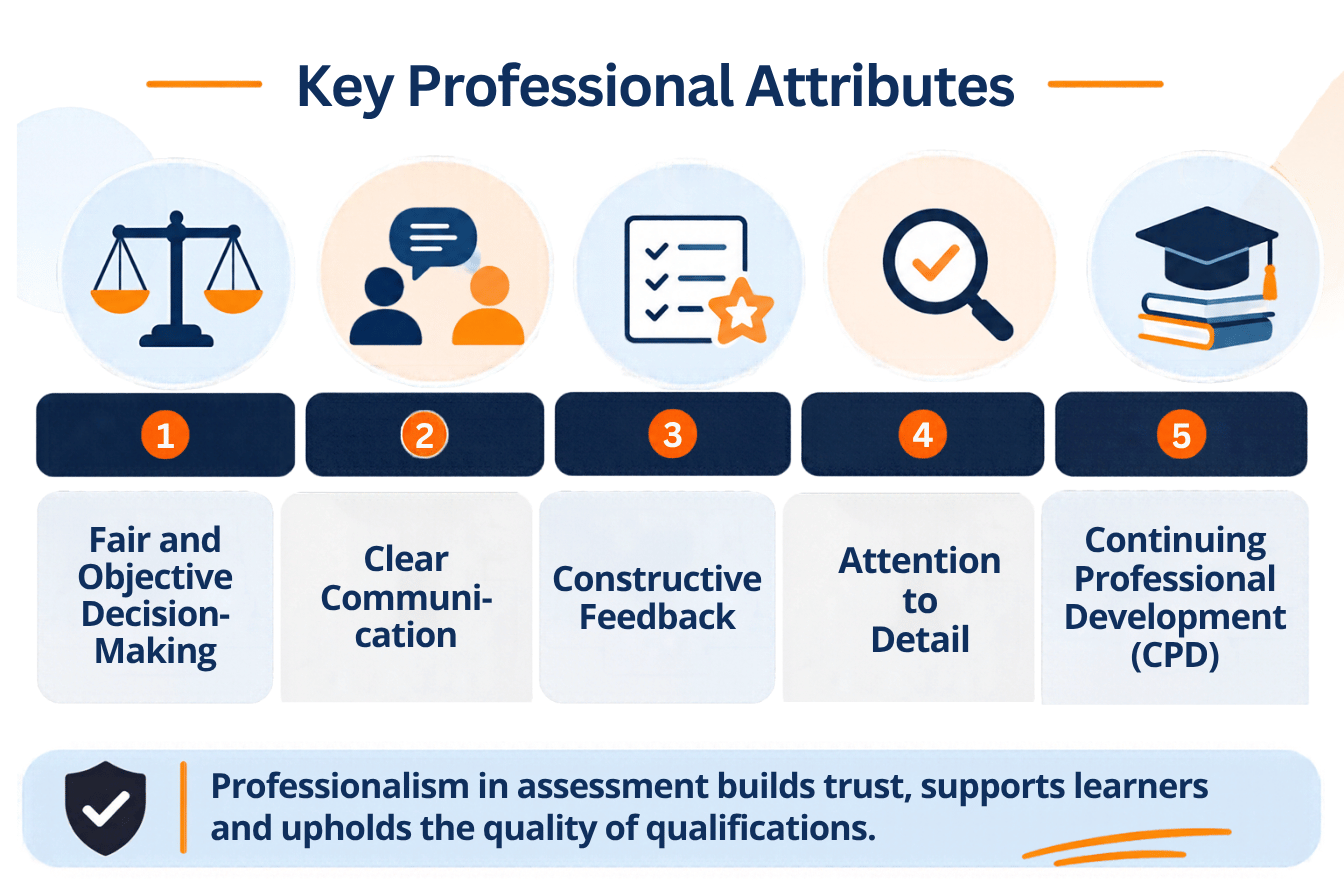
Completing an assessor course is an important achievement, but developing professional judgement takes continued experience. Effective assessors combine technical knowledge with communication and a commitment to helping learners progress.
|
Professional Attribute |
Description |
|
| ⚖︎ |
Fair and Objective Decision-Making |
An assessor should make decisions based on evidence rather than assumptions, personal relationships or individual preferences. |
| ✉︎ |
Clear Communication |
Learners need to understand what is expected, how their work will be assessed and what they can do to improve. |
| ✓ |
Constructive Feedback |
Useful feedback identifies specific achievements and explains what further evidence or improvement is needed. |
| ⌕ |
Attention to Detail |
Assessment records must be accurate, secure and appropriate for quality assurance purposes. |
| ↻ |
Continuing Professional Development (CPD) |
Industry practices, occupational standards and qualification requirements can change. Maintaining up-to-date professional knowledge helps assessors remain effective and credible. |
Assessor Salary and Career Outlook in the UK
According to the National Careers Service, typical annual salaries for RQF assessors range from around £22,000 for starters to £35,000 for experienced professionals. Actual pay depends on employer, location, sector, responsibilities and experience.
Beyond pay, assessing lets you shape vocational skills development directly. You might help an apprentice prove competence, support an experienced worker gaining formal recognition, or guide a learner toward their next career move.
What Comes After Becoming a Qualified Assessor?
A Level 3 assessor qualification is a starting point. With experience and further training, assessors often move into internal quality assurance, assessment leadership or training management. If you want to check the quality and consistency of assessment decisions, a Level 4 Internal Quality Assurance (IQA) qualification is the natural next step.
Frequently Asked Questions About Becoming a Qualified Assessor
❓ How do I become a qualified NVQ assessor in the UK?
You generally need relevant occupational experience, suitable subject knowledge, and a recognised assessor qualification. The Level 3 Certificate in Assessing Vocational Achievement is one option for assessing in both workplace and training environments.
❓ Can I complete an assessor qualification online?
Yes. School of Academics delivers its Level 3 assessor courses online. Qualifications with practical units still require real-world assessment evidence.
❓ Do I need a degree to become an assessor?
No. A university degree is not a universal requirement. Requirements depend on the subject you assess, the career route and the expectations of your employer or awarding organisation.
❓ How long does it take to become a qualified assessor?
It depends on the qualification, your study pace and access to learners. School of Academics recommends up to four months for its Level 3 CAVA course.
❓ Is CAVA the same as A1 Assessor?
No. CAVA is part of the newer suite of assessor qualifications that succeeded older arrangements such as A1. Both relate to vocational assessment, but they are not identical.
❓ What if I do not have learners to assess yet?
Start with the theory-based Level 3 Award in Understanding the Principles and Practices of Assessment, or ask your training provider about placement options and practical assessment arrangements.
❓ Is becoming a qualified assessor a good career move?
For experienced professionals who enjoy supporting others, assessor training can create opportunities to use existing skills in a different way. It may appeal if you want to move towards education, workplace learning or professional development without leaving your industry entirely.
Ready to Become a Qualified Assessor?
Becoming a qualified assessor does not mean leaving your experience behind. It means using what you know in a new way. The right Level 3 qualification gives you the structured skills to assess learners fairly and support recognised vocational achievement.
Whether you are a construction specialist, care professional, hospitality manager or experienced workplace trainer, your next step could be helping others prove the skills you have spent years building.
At Britannia School of Academics, you can study flexible, Ofqual-regulated online assessor qualifications with dedicated tutor support.
Ready to become a qualified assessor?
Explore our Ofqual-regulated Level 3 CAVA course and turn your experience into a recognised next step.
Explore the Level 3 CAVA course