 WhatsApp Us



Internal Quality Assurance (IQA) is the framework that protects the quality, fairness and credibility of vocational qualifications. For a training provider, well-designed IQA policies and procedures for vocational training do more than prepare the centre for an audit. They help assessors make consistent decisions, enable tutors to improve delivery, and give learners confidence that their achievements are valid.
Key Takeaways:
- Well-built IQA policies and procedures turn internal quality assurance from a last-minute paperwork exercise into an everyday, evidence-based habit.
- Awarding organisation's requirements, a risk-based sampling plan and regular standardisation are the three foundations of a defensible system.
- An effective IQA policy should define responsibilities, sampling, standardisation, feedback, record-keeping and review processes to maintain consistent assessment quality and compliance.
Whether you are an aspiring Internal Quality Assurer, an experienced assessor, a tutor or a learner, understanding how the system works is essential. This guide explains the key components of an effective IQA system and provides practical tools you can adapt to your centre’s provision, awarding organisation requirements and regulatory responsibilities.
Picture the day before an External Quality Assurance (EQA) visit. The IQA folder is full of sampling forms, yet three assessors describe three different ways of giving feedback, and nobody can say when the policy was last reviewed. The paperwork exists, but the system does not.
That gap is exactly what effective IQA policies and procedures close. Whether you are a learner curious about how your work is checked, an assessor preparing for sampling, a trainer building a quality culture, or an IQA writing a policy from scratch, this guide shows how to develop a policy that works in practice as well as on paper.
Why IQA Policies and Procedures Matter in Vocational Training
The role of the IQA in vocational education is to monitor assessment so that decisions are valid, reliable, fair and consistent, whoever the assessor is and wherever the learner studies. A policy is how a centre makes that promise visible and repeatable. Ofqual regulates awarding organisations in England, and awarding organisations in turn set the quality assurance requirements that centres must meet, so a clear policy is also your first line of compliance.
A good system also protects people. Learners can trust that their work is judged against the same standard as everyone else's. Assessors get timely, specific feedback. Leaders can show, with evidence, how quality decisions were made.
Policy, Procedure and Template: What Is The Difference?
These three terms are often blurred. Keeping them separate makes your documents shorter, clearer and easier to review.
| Document | The
question it answers |
Example
in IQA |
| Policy |
What do we commit to, and why? |
Every assessor will be sampled across the year
using a risk-based plan. |
| Procedure |
Who does what, when and how? |
The steps for planning, carrying out and
recording a sampling activity |
| Template |
How do we record it consistently? |
Sampling plan, IQA report, standardisation
record, action log |
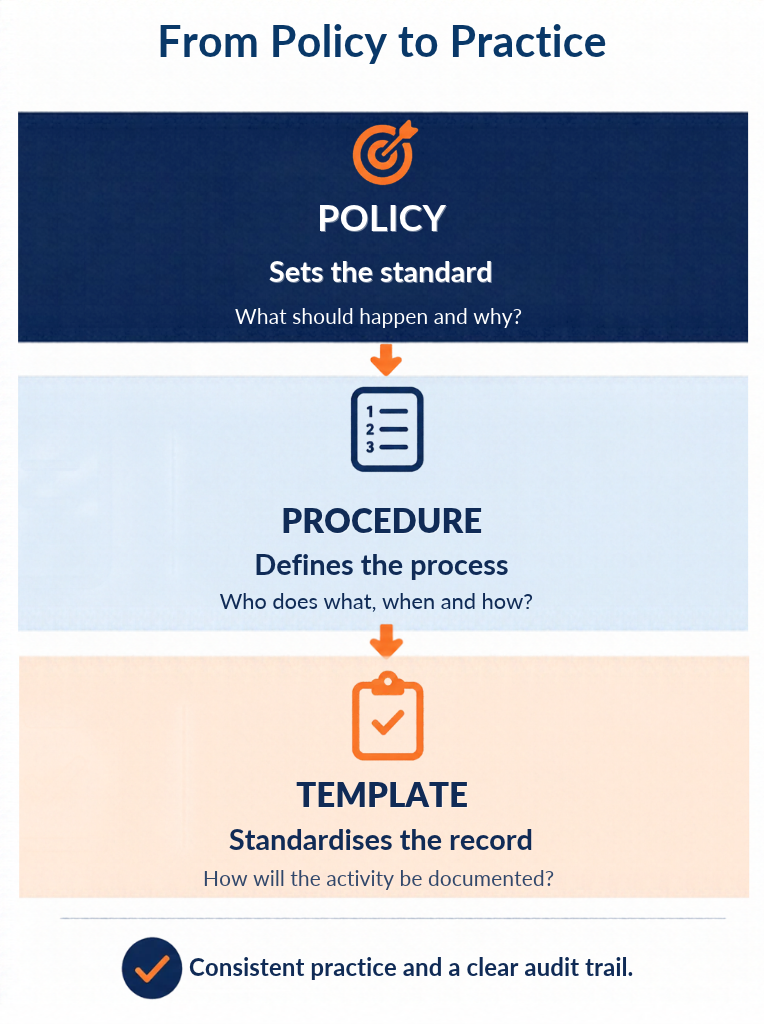
A policy tells people what should happen. A procedure explains how to do it. A template provides a consistent format for recording the evidence that it happened.
What A Strong IQA Policy Should Contain
An effective IQA policy should address the following key areas to ensure that quality assurance arrangements are clear, consistent and aligned with awarding organisation requirements.
- Purpose and scope: Define the qualifications, awarding organisations, delivery locations and learning methods covered by the policy.
- Roles and responsibilities: Clarify the responsibilities of the Lead IQA, IQAs, assessors and managers, including decision-making authority and the management of conflicts of interest.
- IQA competence and CPD: Set out the required qualifications, relevant occupational and assessment knowledge, and arrangements for continuing professional development.
- Sampling strategy: Explain how sampling is planned, including sample size, frequency, assessment methods, learner groups and risk factors.
- Standardisation: Establish how often standardisation takes place, who participates, how outcomes are recorded and how consistent assessment decisions are maintained.
- Feedback and action planning: Define feedback timescales, corrective actions, responsible staff, completion deadlines and escalation arrangements.
- Records and retention: Specify the evidence to be maintained, storage arrangements, retention periods, access permissions and data protection requirements.
- Appeals, complaints and malpractice: Explain how IQA findings link to the centre's appeals, complaints and malpractice procedures, including the referral of concerns for investigation.
- Adjustments, remote and AI-assisted assessment: Set out how reasonable adjustments are managed and how learner identity, evidence authenticity and assessment integrity are protected.
- Monitoring and review: Identify the policy owner, review schedule, version control arrangements and approval process.
Ready to Develop Your IQA Skills?
Build the knowledge and practical skills needed to internally quality assure assessment decisions, support assessors and maintain consistent assessment standards with the Level 4 Award in the Internal Quality Assurance of Assessment Processes and Practices (RQF).
Explore the Level 4 IQA AwardWhat are the Six Steps To Develop an IQA Policy In Further Education?
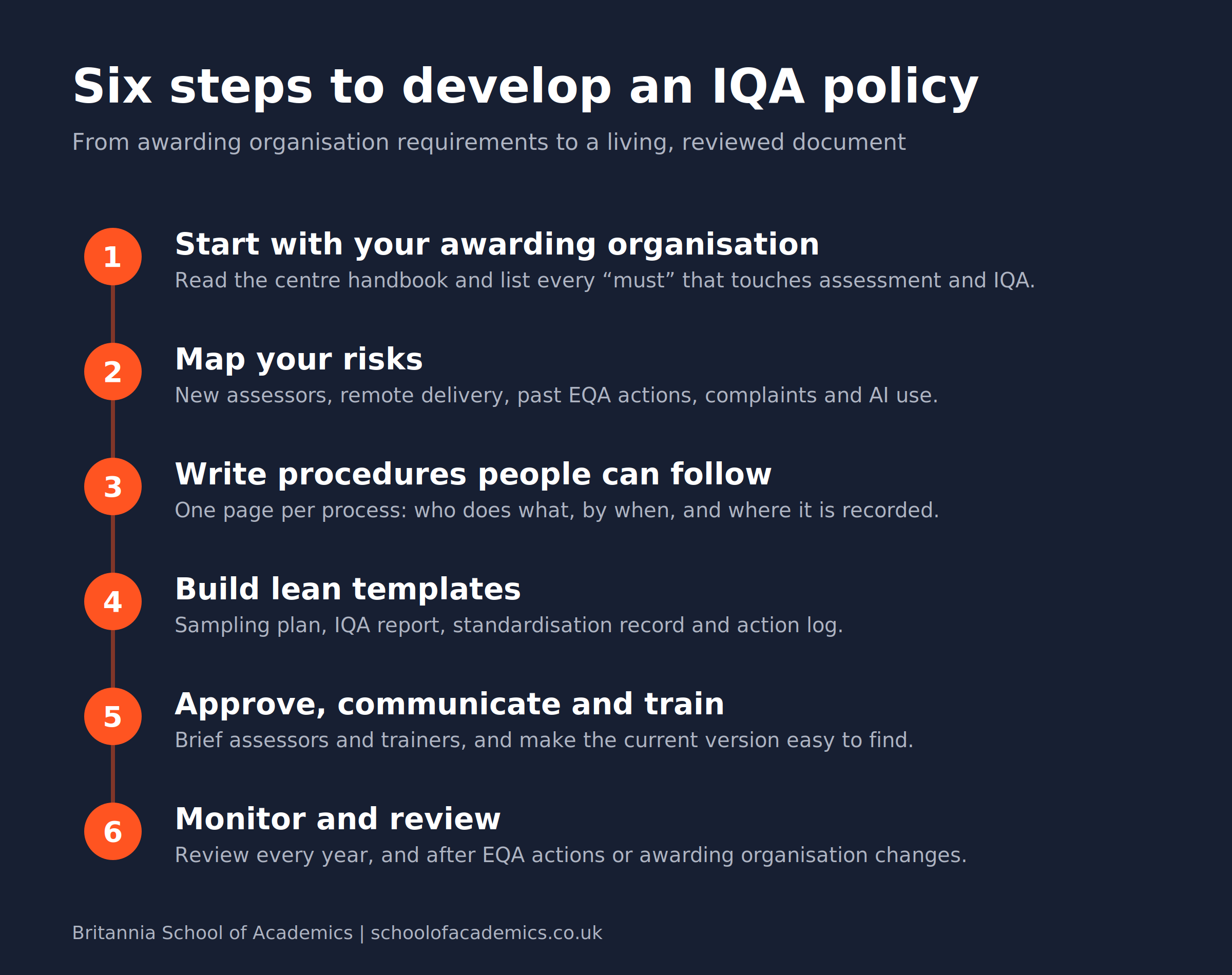
→ Step 1: Start with your awarding organisation
Read the centre handbook, approval criteria and qualification specifications for every awarding organisation you work with. Highlight each “must” and “should” that touches assessment or quality assurance, and make sure your policy answers it. Our guides on the role of the awarding organisation in vocational courses and what makes a regulated qualification a true standard of quality explain why this step comes first.
→ Step 2: Map your risks
List what could undermine assessment decisions in your centre: new or associate assessors, high-volume units, remote delivery, past EQA actions, complaints, or the use of AI tools by learners. These risks decide where your sampling effort goes.
→ Step 3: Write procedures people can actually follow
One page per process is usually enough. Name the role responsible for each step, state the timescale, and say where the record is stored. If a new IQA cannot follow it on their first day, it needs simplifying.
→ Step 4: Build lean templates
Start with four: a sampling plan, an IQA report, a standardisation record and an action log. Fewer, well-designed templates are filled in more consistently than a long list of forms.
→ Step 5: Approve, communicate and train
A policy that sits in a shared drive does not change practice. Brief assessors and trainers, explain what sampling will look like, and make sure everyone knows where to find the current version.
→ Step 6: Monitor and review
Review the policy on a set cycle (annually is common good practice) and sooner when awarding organisation requirements change, an EQA report raises actions, or a significant incident occurs. Record each change in a version log.
IQA Sampling Plan Templates: Planning Coverage That Stands Up To Scrutiny
Sampling is the engine of any IQA system. A strong plan is risk-based, representative and documented, showing professional judgement rather than a fixed percentage applied to everyone. It should also consider holistic sampling: looking across a learner's whole journey, from initial assessment to the final decision, instead of checking isolated units. For a deeper look at balancing assessors, learners, methods, units and risk, read our guide to best practices for internal quality assurance.
Here is a simple template you can adapt, with one worked example row.
|
Assessor |
Qualification / unit |
Method |
Learners sampled |
Stage |
Risk rating |
Planned date |
Outcome and action |
|
Assessor A (new) |
The programme, unit or assessment area being sampled. |
Observation and product evidence |
2 of 6 |
Interim |
High |
Week 4 |
Feedback given; action to link comments to criteria; resample in Week 8 |
Planning tips
- Sample early for new assessors, new units and new delivery models so problems are fixed before they spread.
- Use interim sampling to confirm that earlier actions worked.
- Use summative sampling to check final decisions before certification claims.
- Always check your awarding organisation's requirements, as some set minimum expectations.
Standardisation, Feedback And Records: Making Policy Visible In Practice
A policy shows its value in the way people work. Three habits make the difference.
- Standardisation. Assessors review the same evidence, make their own decisions first, then compare them against the criteria. Record what was agreed and check later sampling to confirm it is being applied.
- Feedback that leads to action. Every IQA finding should say what was checked, what was done well, what must change, who owns the change and by when.
- Records that tell the story. An audit trail should show what was planned, what was sampled, what was found and whether the action improved practice.
Understanding how these internal checks connect to external scrutiny also helps. Our article on the difference between IQAs and EQAs explains how the two roles fit together, and IQA in assessment: key responsibilities and best practices breaks down who does what.
Awarding Organisation Quality Assurance Requirements: A Compliance Map
Requirements vary between awarding organisations and qualifications, so always treat your own centre handbook as the final authority. The table below shows the areas that commonly matter and where your policy should respond to them.
|
Requirement area |
What awarding organisations commonly expect |
Where your policy shows it |
|
Centre approval and agreement |
Documented systems for assessment and quality assurance |
Purpose, scope, and review sections |
|
Competent staff |
Assessors and IQAs with suitable occupational knowledge and qualifications, or working towards them |
IQA competence and CPD section |
|
Sampling and decisions |
Evidence that assessment decisions are checked across assessors, methods and learners |
Sampling strategy and plan template |
|
EQA access and actions |
Records available for EQA, with timely responses to actions |
Records and escalation sections |
|
Malpractice and maladministration |
Clear procedures to identify, investigate and report concerns |
Appeals, complaints and malpractice section |
|
Fairness and adjustments |
Reasonable adjustments applied correctly and consistently |
Adjustments, remote and AI-assisted assessment section |
Two areas deserve particular attention at the moment. First, AI and digital evidence: your policy should state what AI use is acceptable and what extra evidence, such as questioning or professional discussion, you may use when authenticity is in doubt. See AI in vocational assessment for practical strategies. Second, malpractice: our guide to investigating malpractice in education outlines responsibilities and procedures you can link to from your policy.
Common Mistakes to Avoid during Awarding Body QA Audit
The following are the common mistakes training providers make during the quality assurance audit.
⚠ Using a fixed sample percentage for every situation
A percentage alone does not demonstrate effective sampling. Combine routine coverage with risk-based and targeted sampling, and record the rationale for your decisions.
↻ Treating feedback as a one-way inspection report
Feedback should create a dialogue. Give assessors an opportunity to discuss context, ask questions and identify development needs.
☰ Focusing only on documents
Records matter, but quality assurance should also consider assessment practice, learner experience, teaching support and the validity of decisions.
Separating IQA from teaching and learning
When findings never reach tutors or curriculum teams, the centre loses an important opportunity to improve delivery.
Writing a policy nobody can use
Use clear headings, named responsibilities, practical forms and realistic timescales. A concise procedure that staff follow is stronger than a long document that no one understand.
Ready to move from following IQA policy to leading it?
Take your IQA practice further with the Level 4 Certificate in Leading the Internal Quality Assurance of Assessment Processes and Practices (RQF). Designed for professionals who want to lead internal quality assurance, monitor assessment quality and coordinate IQA activity within an organisation.
Enrol TodayFrequently Asked Questions
How often should an IQA policy be reviewed?
Good practice is at least once a year, and sooner when awarding organisation requirements change, an EQA report raises actions, or a significant incident occurs.
Do I need to be a qualified assessor to become an IQA?
Not to begin the Level 4 qualification, but you will need access to assessors' work to complete the practical unit, and employers value occupational and assessment experience.
Can one policy cover several awarding organisations?
Yes. Many centres keep one overarching IQA policy and add short appendices or procedures for the specific requirements of each awarding organisation.
Final Thoughts
Effective IQA policies and procedures are not about producing more paperwork. They give everyone a shared, evidence-based way to protect fairness, support assessors and show how standards are met.
Start small: align your policy to your awarding organisation, build a risk-based sampling plan, and review it regularly. And if you want to be the person who leads that work, the right qualification is only a few clicks away.
Explore the range of courses at School of Academics Assessor and IQA Training Courses that are designed to help educators develop the knowledge and practical capability needed to support high-quality assessment and progress towards IQA responsibilities.
Start building your future in assessment quality assurance with
Britannia School of Academics.