 WhatsApp Us



The first thing you should do when the assignment that you wrote is flagged as AI-written is to stay calm. You can work this out by providing the evidence of your original work process to prove authenticity. This evidence includes notes, drafts, sources you visited with time stamped, library entries and all the early drafts that have gone through gradual improvements.
Key Takeaways:
- AI flag is not proof of misconduct and discover the practical steps students should take immediately.
- Keeping a record of assignment drafts, revision histories, research notes, and supporting evidence can help demonstrate authorship during academic reviews.
- A genuine assignment can be falsely flagged, and how institutional AI policies influence the outcome of investigations.
It is hard to even imagine that you spent so much time and resources while working on an assignment, essay or any research academic document, being detected as AI-Generated. Even when the document is entirely original, an AI flag can create uncertainty and stress.
AI detection tools are becoming more common in the assessment process to support academic integrity. Being flagged does not automatically mean that academic misconduct has occurred. In many cases, a review is simply the beginning of a conversation rather than a final judgement.
This guide explains what to do if your work is flagged as AI-generated.
What an AI Flag Actually Means?
An AI flag means an AI detection tool has identified patterns in an assignment that resemble AI-generated writing. These tools analyse sentence structure, word choice, writing consistency, and language patterns and assign a probability score. The score reflects the level of confidence, not a definitive conclusion.
An assignment with a high score usually means the work may require further review. The flag serves as a signal for assessors to take a closer look. AI reports are often submitted alongside other information during the assessment process.
Good academic writing often includes correct grammar, formal language, clear sentence structure, and subject-specific terms. These are the same features that AI detection tools sometimes associate with AI-generated content.
Because of this, a student who has written an assignment entirely on their own may still receive an AI flag. This is one reason why AI detection reports are usually reviewed alongside other evidence rather than being treated as proof of misconduct.
Understand Your Institution's AI Policy
Every student should review their institution's policy on artificial intelligence and academic integrity. AI rules are not the same everywhere. Some universities, colleges, and training providers have strict restrictions on the use of AI tools in assessments. Others may permit certain uses, such as brainstorming, research support, outlines or language improvement. The only rule is that they are properly declared.
An AI flag should always be considered within the context of the institute's policies. What may be acceptable at one institution could be treated as a breach of academic integrity at another.
If any part of the policy is unclear, seek clarification from your tutor or academic support team.
Here, include a brief practical examples table of permitted and prohibited AI use:
| Potential Permissions | Potentially Prohibited |
|---|---|
| • Generating brainstorming ideas | • Submitting AI answers as your own |
| • Improving sentence clarity | • Using AI to without disclosure |
| • Creating a study plan | • Exam Violation |
What Must Be Done in Case of Falsely Being Flagged as an AI-Generated Assignment?
Given the flag for potential AI use, it is important to take the matter seriously and respond appropriately. The steps you take after receiving a flag can significantly influence how the situation is reviewed and resolved.
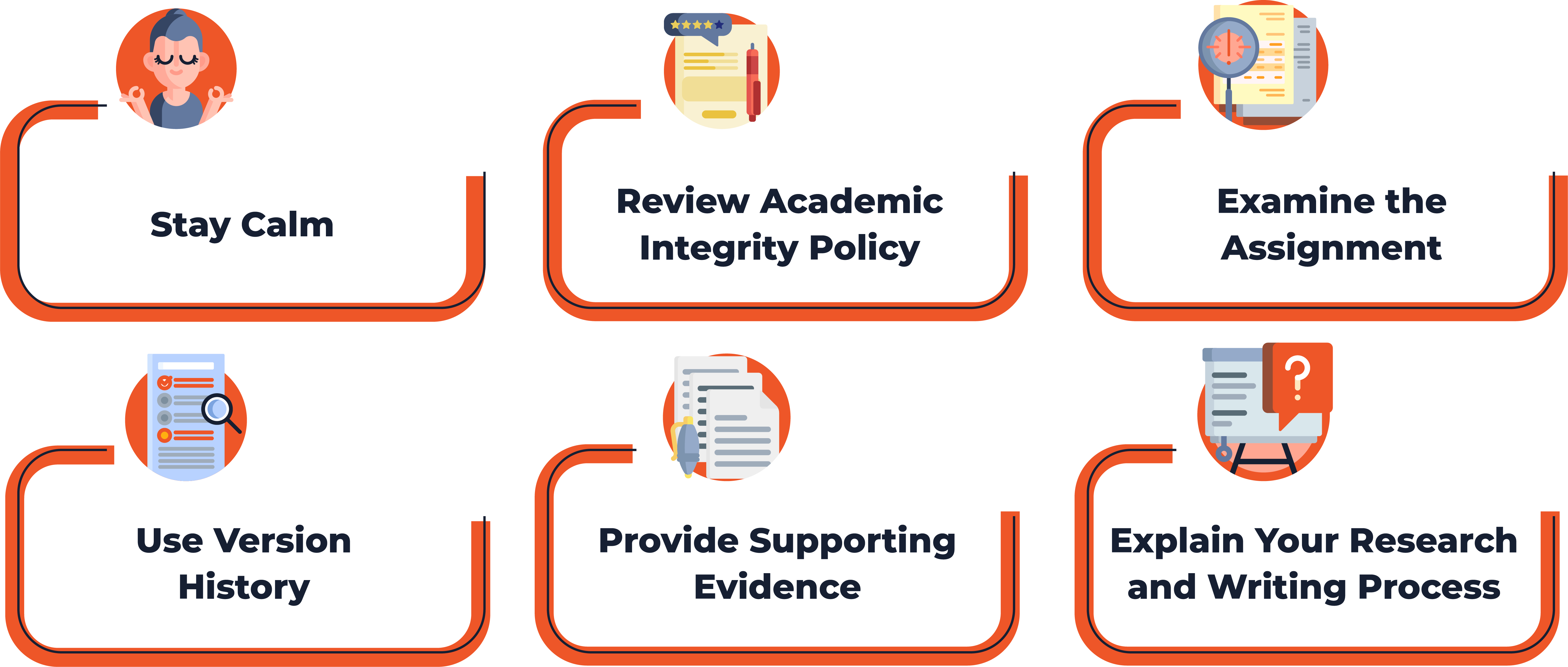
Stay Calm
Receiving an AI flag is really worrying when you have done all the work yourself. Reacting logically is the only way to resolve this issue. Take time to carefully read the notification or email you have received.
It is important to pay attention to the concerns raised; sometimes, tone or perfect grammar is an issue stated by AI detectors. Understanding exactly what is being questioned will help you respond appropriately.
With a simple clarification talk with the institution, the conversation may end positively. You might have to provide additional information before making any decision.
Review Academic Integrity Policy
Familiarise yourself with your institution's policies regarding AI use and academic integrity. Different institutions have different rules. Some prohibit most forms of AI assistance, while others allow limited use under specific conditions.
Knowing the policy will help you understand how the review process works. You will also know what evidence may be required and what options are available if you disagree with the outcome.
Examine the Assignment
Review the assignment yourself. Look for any sections that differ noticeably in style, tone, structure or complexity from the rest of the document. Also check that all sources have been properly cited and referenced.
A careful review can help you identify areas that may have attracted attention. Replace or edit the section as per your personal writing style. Prepare explanations for any questions raised about specific sections.
Use Version History
Many writing platforms automatically record changes made to a document over time. Google Docs, Microsoft Word, and similar tools often provide version histories that show when content was added, edited, or revised.
A detailed revision history can be valuable evidence because it illustrates the gradual development of your assignment and supports your claim that the work was created by you.
Provide Supporting Evidence
When communicating with tutors or assessors, remain professional and focus on the facts. Avoid becoming defensive or argumentative. Explain your position clearly and provide any supporting documents that demonstrate how the assignment was produced.
Provide the materials that demonstrate your work process. These materials can be planning notes, outlines, research documents, rough drafts, and feedback received during development.
A well-organised and respectful response is more likely to help the review process move forward efficiently.
Explain Your Research and Writing Process
In some cases, you may be asked to discuss your assignment during a meeting or academic review. Be ready to explain how you selected your topic, gathered information, structured your arguments, and developed your final submission.
Being able to confidently discuss your work demonstrates familiarity with the content and can provide further evidence that the assignment reflects your own knowledge and effort.
𝗘𝗻𝗵𝗮𝗻𝗰𝗲 𝗬𝗼𝘂𝗿 𝗔𝗜 𝗦𝗸𝗶𝗹𝗹𝘀 𝗮𝘀 𝗮𝗻 𝗘𝗱𝘂𝗰𝗮𝘁𝗼𝗿
Learn to use AI responsibly with Level 3 Award in Artificial Intelligence (AI) in Education
Enrol NowCan AI Detectors Falsely Flag Human-Written Work?
Yes, AI detectors can falsely flag human-written assignments. This is one of the most widely recognised limitations of AI detection technology.
This means that a genuine assignment can sometimes be identified as potentially AI-generated.
Common reasons why human-written work may be flagged include:
-
Formal academic writing style: Academic assignments are expected to follow a professional and structured tone, which can resemble AI-generated content.
-
Strong grammar and sentence structure: Well-written assignments with few grammatical errors may sometimes receive higher AI scores.
-
Consistent writing patterns: A clear and uniform writing style throughout an assignment can be interpreted as AI-like by some detection tools.
-
Use of common academic phrases: Frequently used academic expressions and transition words may influence detection results.
-
Subject-specific terminology: Technical vocabulary and discipline-specific language can sometimes trigger AI detection systems.
-
Well-edited content: Assignments that have been carefully revised and polished may appear more predictable to AI detectors.
An AI flag should generally be viewed as a signal for further review rather than proof of academic misconduct. Most institutions consider additional evidence before making a final decision.
Final Thoughts
An AI flag does not automatically mean that a student has engaged in academic misconduct. It is often the starting point of a review process. If your assignment is flagged, focus on understanding the concerns raised, reviewing your institution's policies, and providing evidence that demonstrates how your work was developed.
Keeping drafts, research notes, and version histories can make it easier to prove authorship if questions arise. Most importantly, remain professional and transparent throughout the process.
A well-documented writing process and a clear explanation of your work can go a long way in resolving concerns and protecting your academic integrity.



.png)